
Latest Updates
Phio Pharmaceuticals Reports First Quarter 2026 Financial Results and Business Update

Phio Pharmaceuticals (NASDAQ: PHIO) to present its INTASYL® siRNA platform and PH-762 program at the Renmark Live Virtual Non-Deal Roadshow on Thursday, May 28, 2026.
Phio Pharmaceuticals Corp. (NASDAQ: PHIO) will join Renmark Financial Communications’ Live Virtual Non-Deal Roadshow Series on Thursday, May 28, 2026, at 12 PM EDT. CEO and Chairman Robert Bitterman will present an overview of the Company’s INTASYL® siRNA gene silencing platform, including its lead clinical candidate PH-762 for the treatment of cutaneous carcinomas, followed by a live Q&A.
Phio Pharmaceuticals Corp. is a B2i Digital Featured Company. See the company’s profile at https://b2idigital.com/phio-pharmaceuticals.
INTASYL is a proprietary RNA interference platform designed to enhance the body’s immune cells to more effectively kill cancer cells. Phio’s lead clinical candidate, PH-762, silences the PD-1 gene implicated in various forms of skin cancer and is being evaluated in a Phase 1b trial (NCT# 06014086) for cutaneous squamous cell carcinoma, melanoma, and Merkel cell carcinoma as a potential non-surgical treatment.
“We look forward to participating in the Renmark Virtual Non-Deal Roadshow, where we will discuss why we believe INTASYL represents a differentiated and promising approach in immuno-oncology,” said Robert Bitterman, CEO and Chairman of Phio Pharmaceuticals.
Register for the event: https://www.renmarkfinancial.com/live-registration/renmark-virtual-non-deal-roadshow-nasdaq-phio-Mbp9ao86qh
See the full release: https://phiopharma.com/phio-pharmaceuticals-announces-participation-in-the-renmark-financial-communications-live-virtual-non-deal-roadshow-series-5/
Phio Pharmaceuticals Corp. is a clinical-stage siRNA biopharmaceutical company developing therapeutics through its proprietary INTASYL gene silencing technology. INTASYL compounds are designed to enhance the body’s immune cells to more effectively kill cancer cells, with lead candidate PH-762 advancing as a potential non-surgical treatment for skin cancers.
Phio is led by Robert Bitterman, CEO and Chairman of the Board.
Learn more at [www.phiopharma.com](https://www.phiopharma.com).
Phio Pharmaceuticals Corp. (NASDAQ: PHIO) will join Renmark Financial Communications’ Live Virtual Non-Deal Roadshow Series on Thursday, May 28, 2026, at 12 PM EDT. CEO and Chairman Robert Bitterman will present an overview of the Company’s INTASYL® siRNA gene silencing platform, including its lead clinical candidate PH-762 for the treatment of cutaneous carcinomas, followed by a live Q&A.
Phio Pharmaceuticals Corp. is a B2i Digital Featured Company. See the company’s profile at https://b2idigital.com/phio-pharmaceuticals.
INTASYL is a proprietary RNA interference platform designed to enhance the body’s immune cells to more effectively kill cancer cells. Phio’s lead clinical candidate, PH-762, silences the PD-1 gene implicated in various forms of skin cancer and is being evaluated in a Phase 1b trial (NCT# 06014086) for cutaneous squamous cell carcinoma, melanoma, and Merkel cell carcinoma as a potential non-surgical treatment.
“We look forward to participating in the Renmark Virtual Non-Deal Roadshow, where we will discuss why we believe INTASYL represents a differentiated and promising approach in immuno-oncology,” said Robert Bitterman, CEO and Chairman of Phio Pharmaceuticals.
Register for the event: https://www.renmarkfinancial.com/live-registration/renmark-virtual-non-deal-roadshow-nasdaq-phio-Mbp9ao86qh
See the full release: https://phiopharma.com/phio-pharmaceuticals-announces-participation-in-the-renmark-financial-communications-live-virtual-non-deal-roadshow-series-5/
Phio Pharmaceuticals Corp. is a clinical-stage siRNA biopharmaceutical company developing therapeutics through its proprietary INTASYL gene silencing technology. INTASYL compounds are designed to enhance the body’s immune cells to more effectively kill cancer cells, with lead candidate PH-762 advancing as a potential non-surgical treatment for skin cancers.
Phio is led by Robert Bitterman, CEO and Chairman of the Board.
Learn more at [www.phiopharma.com](https://www.phiopharma.com).
Read more
@b2i_digital
May 27
B2i Digital
May 22
Phio Pharmaceuticals Corp. (NASDAQ: PHIO) President and CEO Robert Bitterman recently presented at the Second Annual Centri Capital Conference at Nasdaq MarketSite, hosted by Centri Business Consulting. In this clip, he outlines the path to the next phase of clinical development.
Phio Pharmaceuticals is a B2i Digital Featured Company (https://lnkd.in/ggze69xx) developing immuno-oncology therapies built on its proprietary INTASYL self-delivering short interfering RNA platform. For more information, visit https://www.phiopharma.com and follow Phio on LinkedIn.
"We're seeking guidance from the FDA, having accumulated all of the data from this first study, and we expect that we'll be seeking information from them in Q2 with input received from FDA sometime in Q3, with the intention then to go and move into a next phase trial in the first quarter of next year," Bitterman said, walking through the regulatory and clinical timeline.
The balance sheet Phio is carrying into those regulatory conversations:
• Phio ended the year with $21 million in cash, providing runway into the first half of 2027 under current operating plans.
• The next twelve months feature a clear cadence of regulatory interactions (Q2 input requested, Q3 feedback received, Q1 2027 next trial initiation) that give investors concrete inflection points to track.
• An ATM facility with $6.3 million of available capacity is set up but not currently in use at prevailing share price levels. Management has indicated a preference for minimizing dilution of existing shareholders.
• The capital structure is clean: 11.6 million shares outstanding, 13.4 million warrants exercisable at $2.50, and no debt.
• The secondary program PH-894 (targeting BRD4) has completed IND-enabling studies and is positioned to advance following FDA feedback on PH-762.
Watch the full presentation, courtesy of Centri Business Consulting: https://lnkd.in/gWZ2WKn2
Phio Pharmaceuticals is led by Robert Bitterman, President and Chief Executive Officer, who has served on the company's board since 2012. Mr. Bitterman previously founded and led Cutanea Life Sciences, and earlier in his career held executive roles at Isolagen, Dermik Laboratories, and Aventis.
For additional details, please visit the Investors section of Phio's website at: https://lnkd.in/gyAP456M.
Discover more emerging growth Featured Companies, industry-leading Featured Experts, and upcoming Featured Conferences at https://b2idigital.com. Disclosure: B2i Digital is not a broker-dealer or investment adviser. This post is informational and not an offer or solicitation regarding any security.
Phio Pharmaceuticals is a B2i Digital Featured Company (https://lnkd.in/ggze69xx) developing immuno-oncology therapies built on its proprietary INTASYL self-delivering short interfering RNA platform. For more information, visit https://www.phiopharma.com and follow Phio on LinkedIn.
"We're seeking guidance from the FDA, having accumulated all of the data from this first study, and we expect that we'll be seeking information from them in Q2 with input received from FDA sometime in Q3, with the intention then to go and move into a next phase trial in the first quarter of next year," Bitterman said, walking through the regulatory and clinical timeline.
The balance sheet Phio is carrying into those regulatory conversations:
• Phio ended the year with $21 million in cash, providing runway into the first half of 2027 under current operating plans.
• The next twelve months feature a clear cadence of regulatory interactions (Q2 input requested, Q3 feedback received, Q1 2027 next trial initiation) that give investors concrete inflection points to track.
• An ATM facility with $6.3 million of available capacity is set up but not currently in use at prevailing share price levels. Management has indicated a preference for minimizing dilution of existing shareholders.
• The capital structure is clean: 11.6 million shares outstanding, 13.4 million warrants exercisable at $2.50, and no debt.
• The secondary program PH-894 (targeting BRD4) has completed IND-enabling studies and is positioned to advance following FDA feedback on PH-762.
Watch the full presentation, courtesy of Centri Business Consulting: https://lnkd.in/gWZ2WKn2
Phio Pharmaceuticals is led by Robert Bitterman, President and Chief Executive Officer, who has served on the company's board since 2012. Mr. Bitterman previously founded and led Cutanea Life Sciences, and earlier in his career held executive roles at Isolagen, Dermik Laboratories, and Aventis.
For additional details, please visit the Investors section of Phio's website at: https://lnkd.in/gyAP456M.
Discover more emerging growth Featured Companies, industry-leading Featured Experts, and upcoming Featured Conferences at https://b2idigital.com. Disclosure: B2i Digital is not a broker-dealer or investment adviser. This post is informational and not an offer or solicitation regarding any security.
Read more
David Shapiro
May 22

Phio Pharmaceuticals Corp. (NASDAQ: PHIO) President and CEO Robert Bitterman recently presented at the Second Annual Centri Capital Conference at Nasdaq MarketSite, hosted by Centri Business Consulting. In this clip, he outlines the path to the next phase of clinical development.
Phio Pharmaceuticals is a B2i Digital Featured Company (https://b2idigital.com/phio-pharmaceuticals) developing immuno-oncology therapies built on its proprietary INTASYL self-delivering short interfering RNA platform. For more information, visit https://www.phiopharma.com and follow Phio on LinkedIn.
"We're seeking guidance from the FDA, having accumulated all of the data from this first study, and we expect that we'll be seeking information from them in Q2 with input received from FDA sometime in Q3, with the
Phio Pharmaceuticals is a B2i Digital Featured Company (https://b2idigital.com/phio-pharmaceuticals) developing immuno-oncology therapies built on its proprietary INTASYL self-delivering short interfering RNA platform. For more information, visit https://www.phiopharma.com and follow Phio on LinkedIn.
"We're seeking guidance from the FDA, having accumulated all of the data from this first study, and we expect that we'll be seeking information from them in Q2 with input received from FDA sometime in Q3, with the
Read more

B2i Digital
May 27
Phio Pharmaceuticals (NASDAQ: PHIO) to present its INTASYL® siRNA platform and PH-762 program at the Renmark Live Virtual Non-Deal Roadshow on Thursday, May 28, 2026.
Phio Pharmaceuticals Corp. (NASDAQ: PHIO) will join Renmark Financial Communications’ Live Virtual Non-Deal Roadshow Series on Thursday, May 28, 2026, at 12 PM EDT. CEO and Chairman Robert Bitterman will present an overview of the Company’s INTASYL® siRNA gene silencing platform, including its lead clinical candidate PH-762 for the treatment of cutaneous carcinomas, followed by a live Q&A.
Phio Pharmaceuticals Corp. is a B2i Digital Featured Company. See the company’s profile at https://lnkd.in/ggze69xx.
INTASYL is a proprietary RNA interference platform designed to enhance the body’s immune cells to more effectively kill cancer cells. Phio’s lead clinical candidate, PH-762, silences the PD-1 gene implicated in various forms of skin cancer and is being evaluated in a Phase 1b trial (NCT# 06014086) for cutaneous squamous cell carcinoma, melanoma, and Merkel cell carcinoma as a potential non-surgical treatment.
“We look forward to participating in the Renmark Virtual Non-Deal Roadshow, where we will discuss why we believe INTASYL represents a differentiated and promising approach in immuno-oncology,” said Robert Bitterman, CEO and Chairman of Phio Pharmaceuticals.
Register for the event: https://lnkd.in/gyGVcTGj
See the full release: https://lnkd.in/g4srTx7T
Phio Pharmaceuticals Corp. is a clinical-stage siRNA biopharmaceutical company developing therapeutics through its proprietary INTASYL gene silencing technology. INTASYL compounds are designed to enhance the body’s immune cells to more effectively kill cancer cells, with lead candidate PH-762 advancing as a potential non-surgical treatment for skin cancers.
Phio is led by Robert Bitterman, CEO and Chairman of the Board.
Learn more at [www.phiopharma.com](https://www.phiopharma.com). Discover more emerging growth Featured Companies at [b2idigital.com](https://b2idigital.com).
Disclosure: B2i Digital is not a broker-dealer or investment adviser. This post is informational and not an offer or solicitation regarding any security.
Phio Pharmaceuticals Corp. (NASDAQ: PHIO) will join Renmark Financial Communications’ Live Virtual Non-Deal Roadshow Series on Thursday, May 28, 2026, at 12 PM EDT. CEO and Chairman Robert Bitterman will present an overview of the Company’s INTASYL® siRNA gene silencing platform, including its lead clinical candidate PH-762 for the treatment of cutaneous carcinomas, followed by a live Q&A.
Phio Pharmaceuticals Corp. is a B2i Digital Featured Company. See the company’s profile at https://lnkd.in/ggze69xx.
INTASYL is a proprietary RNA interference platform designed to enhance the body’s immune cells to more effectively kill cancer cells. Phio’s lead clinical candidate, PH-762, silences the PD-1 gene implicated in various forms of skin cancer and is being evaluated in a Phase 1b trial (NCT# 06014086) for cutaneous squamous cell carcinoma, melanoma, and Merkel cell carcinoma as a potential non-surgical treatment.
“We look forward to participating in the Renmark Virtual Non-Deal Roadshow, where we will discuss why we believe INTASYL represents a differentiated and promising approach in immuno-oncology,” said Robert Bitterman, CEO and Chairman of Phio Pharmaceuticals.
Register for the event: https://lnkd.in/gyGVcTGj
See the full release: https://lnkd.in/g4srTx7T
Phio Pharmaceuticals Corp. is a clinical-stage siRNA biopharmaceutical company developing therapeutics through its proprietary INTASYL gene silencing technology. INTASYL compounds are designed to enhance the body’s immune cells to more effectively kill cancer cells, with lead candidate PH-762 advancing as a potential non-surgical treatment for skin cancers.
Phio is led by Robert Bitterman, CEO and Chairman of the Board.
Learn more at [www.phiopharma.com](https://www.phiopharma.com). Discover more emerging growth Featured Companies at [b2idigital.com](https://b2idigital.com).
Disclosure: B2i Digital is not a broker-dealer or investment adviser. This post is informational and not an offer or solicitation regarding any security.
Read more
David Shapiro
May 27

Phio Pharmaceuticals Corp. (NASDAQ: PHIO) President and CEO Robert Bitterman recently presented at the Second Annual Centri Capital Conference at Nasdaq MarketSite, hosted by Centri Business Consulting. In this clip, he outlines the path to the next phase of clinical development.
Phio Pharmaceuticals is a B2i Digital Featured Company (https://b2idigital.com/phio-pharmaceuticals) developing immuno-oncology therapies built on its proprietary INTASYL self-delivering short interfering RNA platform. For more information, visit https://www.phiopharma.com and follow Phio on LinkedIn.
"We're seeking guidance from the FDA, having accumulated all of the data from this first study, and we expect that we'll be seeking information from them in Q2 with input received from FDA sometime in Q3, with the intention then to go and move into a next phase trial in the first quarter of next year," Bitterman said, walking through the regulatory and clinical timeline.
The balance sheet Phio is carrying into those regulatory conversations:
• Phio ended the year with $21 million in cash, providing runway into the first half of 2027 under current operating plans.
• The next twelve months feature a clear cadence of regulatory interactions (Q2 input requested, Q3 feedback received, Q1 2027 next trial initiation) that give investors concrete inflection points to track.
• An ATM facility with $6.3 million of available capacity is set up but not currently in use at prevailing share price levels. Management has indicated a preference for minimizing dilution of existing shareholders.
• The capital structure is clean: 11.6 million shares outstanding, 13.4 million warrants exercisable at $2.50, and no debt.
• The secondary program PH-894 (targeting BRD4) has completed IND-enabling studies and is positioned to advance following FDA feedback on PH-762.
Watch the full presentation, courtesy of Centri Business Consulting: https://youtu.be/X_2b69-0vsY
Phio Pharmaceuticals is led by Robert Bitterman, President and Chief Executive Officer, who has served on the company's board since 2012. Mr. Bitterman previously founded and led Cutanea Life Sciences, and earlier in his career held executive roles at Isolagen, Dermik Laboratories, and Aventis.
For additional details, please visit the Investors section of Phio's website at: https://phiopharma.com/investors/.
Discover more emerging growth Featured Companies, industry-leading Featured Experts, and upcoming Featured Conferences at https://b2idigital.com. Disclosure: B2i Digital is not a broker-dealer or investment adviser. This post is informational and not an offer or solicitation regarding any security.
Phio Pharmaceuticals is a B2i Digital Featured Company (https://b2idigital.com/phio-pharmaceuticals) developing immuno-oncology therapies built on its proprietary INTASYL self-delivering short interfering RNA platform. For more information, visit https://www.phiopharma.com and follow Phio on LinkedIn.
"We're seeking guidance from the FDA, having accumulated all of the data from this first study, and we expect that we'll be seeking information from them in Q2 with input received from FDA sometime in Q3, with the intention then to go and move into a next phase trial in the first quarter of next year," Bitterman said, walking through the regulatory and clinical timeline.
The balance sheet Phio is carrying into those regulatory conversations:
• Phio ended the year with $21 million in cash, providing runway into the first half of 2027 under current operating plans.
• The next twelve months feature a clear cadence of regulatory interactions (Q2 input requested, Q3 feedback received, Q1 2027 next trial initiation) that give investors concrete inflection points to track.
• An ATM facility with $6.3 million of available capacity is set up but not currently in use at prevailing share price levels. Management has indicated a preference for minimizing dilution of existing shareholders.
• The capital structure is clean: 11.6 million shares outstanding, 13.4 million warrants exercisable at $2.50, and no debt.
• The secondary program PH-894 (targeting BRD4) has completed IND-enabling studies and is positioned to advance following FDA feedback on PH-762.
Watch the full presentation, courtesy of Centri Business Consulting: https://youtu.be/X_2b69-0vsY
Phio Pharmaceuticals is led by Robert Bitterman, President and Chief Executive Officer, who has served on the company's board since 2012. Mr. Bitterman previously founded and led Cutanea Life Sciences, and earlier in his career held executive roles at Isolagen, Dermik Laboratories, and Aventis.
For additional details, please visit the Investors section of Phio's website at: https://phiopharma.com/investors/.
Discover more emerging growth Featured Companies, industry-leading Featured Experts, and upcoming Featured Conferences at https://b2idigital.com. Disclosure: B2i Digital is not a broker-dealer or investment adviser. This post is informational and not an offer or solicitation regarding any security.
Read more
B2i Digital
May 21
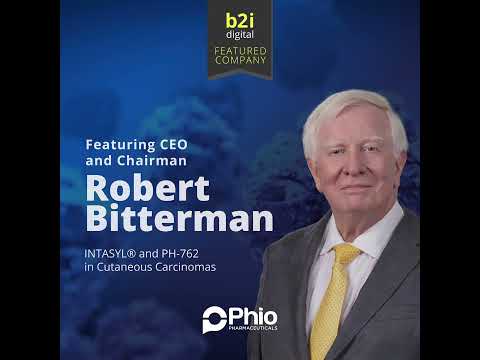
Phio Pharmaceuticals (NASDAQ: PHIO) to present its INTASYL® siRNA platform and PH-762 program at the Renmark Live Virtual Non-Deal Roadshow on Thursday, May 28, 2026.
Phio Pharmaceuticals Corp. (NASDAQ: PHIO) will join Renmark Financial Communications’ Live Virtual Non-Deal Roadshow Series on Thursday, May 28, 2026, at 12 PM EDT. CEO and Chairman Robert Bitterman will present an overview of the Company’s INTASYL® siRNA gene silencing platform, including its lead clinical candidate PH-762 for the treatment of cutaneous carcinomas, followed by a live Q&A.
Phio Pharmaceuticals Corp. is a B2i Digital Featured Company. See the company’s profile at https://b2idigital.com/phio-pharmaceuticals.
INTASYL is a proprietary RNA interference platform designed to enhance the body’s immune cells to more effectively kill cancer cells. Phio’s lead clinical candidate, PH-762, silences the PD-1 gene implicated in various forms of skin cancer and is being evaluated in a Phase 1b trial (NCT# 06014086) for cutaneous squamous cell carcinoma, melanoma, and Merkel cell carcinoma as a potential non-surgical treatment.
“We look forward to participating in the Renmark Virtual Non-Deal Roadshow, where we will discuss why we believe INTASYL represents a differentiated and promising approach in immuno-oncology,” said Robert Bitterman, CEO and Chairman of Phio Pharmaceuticals.
Register for the event: https://www.renmarkfinancial.com/live-registration/renmark-virtual-non-deal-roadshow-nasdaq-phio-Mbp9ao86qh
See the full release: https://phiopharma.com/phio-pharmaceuticals-announces-participation-in-the-renmark-financial-communications-live-virtual-non-deal-roadshow-series-5/
Phio Pharmaceuticals Corp. is a clinical-stage siRNA biopharmaceutical company developing therapeutics through its proprietary INTASYL gene silencing technology. INTASYL compounds are designed to enhance the body’s immune cells to more effectively kill cancer cells, with lead candidate PH-762 advancing as a potential non-surgical treatment for skin cancers.
Phio is led by Robert Bitterman, CEO and Chairman of the Board.
Learn more at [www.phiopharma.com](https://www.phiopharma.com). Discover more emerging growth Featured Companies at [b2idigital.com](https://b2idigital.com).
Disclosure: B2i Digital is not a broker-dealer or investment adviser. This post is informational and not an offer or solicitation regarding any security.
Phio Pharmaceuticals Corp. (NASDAQ: PHIO) will join Renmark Financial Communications’ Live Virtual Non-Deal Roadshow Series on Thursday, May 28, 2026, at 12 PM EDT. CEO and Chairman Robert Bitterman will present an overview of the Company’s INTASYL® siRNA gene silencing platform, including its lead clinical candidate PH-762 for the treatment of cutaneous carcinomas, followed by a live Q&A.
Phio Pharmaceuticals Corp. is a B2i Digital Featured Company. See the company’s profile at https://b2idigital.com/phio-pharmaceuticals.
INTASYL is a proprietary RNA interference platform designed to enhance the body’s immune cells to more effectively kill cancer cells. Phio’s lead clinical candidate, PH-762, silences the PD-1 gene implicated in various forms of skin cancer and is being evaluated in a Phase 1b trial (NCT# 06014086) for cutaneous squamous cell carcinoma, melanoma, and Merkel cell carcinoma as a potential non-surgical treatment.
“We look forward to participating in the Renmark Virtual Non-Deal Roadshow, where we will discuss why we believe INTASYL represents a differentiated and promising approach in immuno-oncology,” said Robert Bitterman, CEO and Chairman of Phio Pharmaceuticals.
Register for the event: https://www.renmarkfinancial.com/live-registration/renmark-virtual-non-deal-roadshow-nasdaq-phio-Mbp9ao86qh
See the full release: https://phiopharma.com/phio-pharmaceuticals-announces-participation-in-the-renmark-financial-communications-live-virtual-non-deal-roadshow-series-5/
Phio Pharmaceuticals Corp. is a clinical-stage siRNA biopharmaceutical company developing therapeutics through its proprietary INTASYL gene silencing technology. INTASYL compounds are designed to enhance the body’s immune cells to more effectively kill cancer cells, with lead candidate PH-762 advancing as a potential non-surgical treatment for skin cancers.
Phio is led by Robert Bitterman, CEO and Chairman of the Board.
Learn more at [www.phiopharma.com](https://www.phiopharma.com). Discover more emerging growth Featured Companies at [b2idigital.com](https://b2idigital.com).
Disclosure: B2i Digital is not a broker-dealer or investment adviser. This post is informational and not an offer or solicitation regarding any security.
Read more

B2i Digital, Inc.
May 27
Phio Pharmaceuticals Corp. (NASDAQ: PHIO) President and CEO Robert Bitterman recently presented at the Second Annual Centri Capital Conference at Nasdaq MarketSite, hosted by Centri Business Consulting. In this clip, he outlines the path to the next phase of clinical development. Phio Pharmaceuticals is a B2i Digital Featured Company (https://b2idigital.com/phio-pharmaceuticals) developing immuno-oncology therapies built on its proprietary INTASYL self-delivering short interfering RNA platform. For more information, visit https://www.phiopharma.com and follow Phio on LinkedIn. "We're seeking guidance from the FDA, having accumulated all of the data from this first study, and we expect that we'll be seeking information from them in Q2 with input received from FDA sometime in Q3, with the intention then to go and move into a next phase trial in the first quarter of next year," Bitterman said, walking through the regulatory and clinical timeline. The balance sheet Phio is carrying into those regulatory conversations: • Phio ended the year with $21 million in cash, providing runway into the first half of 2027 under current operating plans. • The next twelve months feature a clear cadence of regulatory interactions (Q2 input requested, Q3 feedback received, Q1 2027 next trial initiation) that give investors concrete inflection points to track. • An ATM facility with $6.3 million of available capacity is set up but not currently in use at prevailing share price levels. Management has indicated a preference for minimizing dilution of existing shareholders. • The capital structure is clean: 11.6 million shares outstanding, 13.4 million warrants exercisable at $2.50, and no debt. • The secondary program PH-894 (targeting BRD4) has completed IND-enabling studies and is positioned to advance following FDA feedback on PH-762. Watch the full presentation, courtesy of Centri Business Consulting: https://youtu.be/X_2b69-0vsY Phio Pharmaceuticals is led by Robert Bitterman, President and Chief Executive Officer, who has served on the company's board since 2012. Mr. Bitterman previously founded and led Cutanea Life Sciences, and earlier in his career held executive roles at Isolagen, Dermik Laboratories, and Aventis. For additional details, please visit the Investors section of Phio's website at: https://phiopharma.com/investors/. Discover more emerging growth Featured Companies, industry-leading Featured Experts, and upcoming Featured Conferences at https://b2idigital.com. Disclosure: B2i Digital is not a broker-dealer or investment adviser. This post is informational and not an offer or solicitation regarding any security.#stocks #investing #stocktok
Read more

b2idigital
May 21